


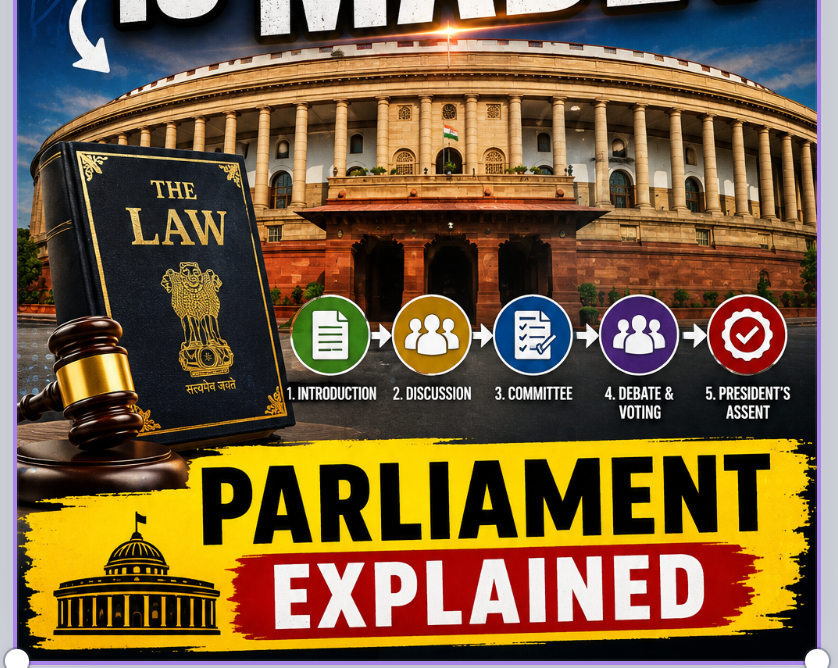
🏛️ How Does Parliament Pass a Law in India?
Have you ever wondered how a new law is made in India?
Every year, Parliament debates and passes several important laws that affect our daily lives—from traffic rules and taxes to education and digital privacy. But before any rule becomes a law, it follows a constitutional process.
In this article, we’ll explain how Parliament passes a law in India in simple language.
📜 What Is a Bill?
A Bill is simply a proposal for a new law or a proposal to amend an existing law.
A Bill is not a law.
It becomes a law only after completing all the constitutional stages and receiving the President’s approval.
There are different types of Bills, including:
- Ordinary Bill
- Money Bill
- Constitutional Amendment Bill
- Finance Bill
- Private Member’s Bill
Each follows a different procedure under the Constitution.
🏛️ Step 1: Introduction of the Bill
The process begins when a Bill is introduced in either Lok Sabha or Rajya Sabha (except certain Money Bills, which can only be introduced in Lok Sabha).
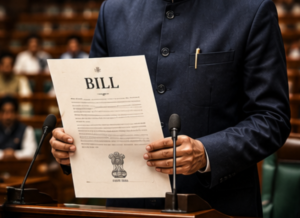

The Bill may be introduced by:
- A Union Minister (Government Bill)
- A Member of Parliament who is not a Minister (Private Member’s Bill)
This stage is called the First Reading.
📖 Step 2: Debate and Discussion
After introduction, Members of Parliament discuss the Bill.
During this stage:
- MPs debate its objectives.
- Experts or Parliamentary Committees may examine it.
- Suggestions and amendments can be proposed.
This ensures different viewpoints are considered before the law is passed.
🗳️ Step 3: Voting in the First House
Once the debate is completed, the House votes on the Bill.
If the majority of members present and voting support the Bill, it is passed by that House.
If not, the Bill fails.
🏛️ Step 4: The Second House
The Bill is then sent to the other House of Parliament.
The second House can:
- Pass the Bill without changes.
- Suggest amendments.
- Reject the Bill.
- Delay consideration (subject to constitutional provisions).
If amendments are made, the Bill may return to the first House for approval.
🤝 What Happens If Lok Sabha and Rajya Sabha Disagree?
For some Ordinary Bills, if both Houses cannot agree, the Constitution provides for a Joint Sitting under specific conditions.
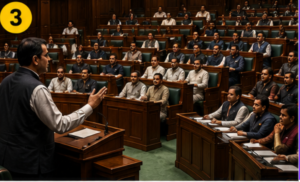

In a Joint Sitting, members of both Houses vote together, and the majority decision prevails.
However, Joint Sittings are not available for every type of Bill, such as Constitutional Amendment Bills or Money Bills.
👨💼 Step 5: President’s Assent
After both Houses have passed the Bill (following the applicable constitutional procedure), it is sent to the President of India.
The President may act according to the constitutional provisions applicable to the Bill.
Once the required assent is given, the Bill becomes an Act of Parliament.
📢 Step 6: Gazette Notification
After becoming an Act, the law is officially published in the Gazette of India.
Depending on the Act, it may:
- Come into force immediately, or
- Come into force on a date notified by the Government.
Why Do Some Bills Take Years?
Not every Bill is passed quickly.
Common reasons include:
- Long parliamentary debates
- Committee examination
- Political disagreements
- Public consultation
- Amendments
- Adjournments or dissolution of the House in some situations
Some Bills remain pending for years before being passed, withdrawn, or lapsing.
Can Every Bill Become a Law?
No.
Many Bills never become laws.


A Bill may:
- Be rejected.
- Be withdrawn.
- Lapse under certain constitutional circumstances.
- Remain pending.
Only Bills that successfully complete the constitutional process become Acts.
Why Is Parliament Important?
Parliament is the law-making body of India.
It represents the people and ensures that laws are debated before implementation.
The legislative process is designed to provide:
- Accountability
- Transparency
- Public representation
- Constitutional checks and balances
Key Takeaways
✅ A Bill is only a proposal—not a law.
✅ Most Bills require approval by both Houses of Parliament according to constitutional procedure.
✅ Debate, amendments, and committee review improve the quality of legislation.
✅ After the required parliamentary approval and Presidential assent, the Bill becomes an Act.
✅ The law is then brought into force according to its provisions and applicable notifications.
📌 Frequently Asked Questions
What is a Bill?
A Bill is a proposal to create a new law or amend an existing law.
What is the difference between a Bill and an Act?
A Bill is a proposal under consideration. Once it completes the required constitutional process and receives the necessary assent, it becomes an Act.
Can Rajya Sabha reject a Bill?
The powers of Rajya Sabha depend on the type of Bill. Different constitutional procedures apply to Ordinary Bills, Money Bills, and Constitutional Amendment Bills.
Who gives the final approval to a Bill?
The President acts according to the constitutional provisions governing Presidential assent after Parliament has completed the legislative process.
Why do some Bills take years?
Because of committee reviews, debates, amendments, political differences, and procedural requirements.
📖 Related Reading
➡️ Will AI Replace Jobs? The Truth About Artificial Intelligence and the Future of Work
➡️ 🛡️ Digital Suraksha – Episode #01: UPI Safety Tips Every User Should Know
➡️ 💰 Why Is Everything Getting Expensive Again?
➡️ ✈️ IndiGo Employee Allegations Explained: What Actually Happened?
➡️ Top 10 Headlines – 16 July 2026
📢 Stay tuned to our blog for daily updates across India! Bookmark this page to get the latest rates every day.
And also visit our page for latest news : https://5pmnews.com
and our YouTube Channel for more informative video this Ritual : https://www.youtube.com/@5PMNewsgyan
Also Watch Visit us on Instagram Channel for more informative reel on this Ritual: https://www.instagram.com/
For any Law related information do visit our page : https://lawyersgyan.com/