


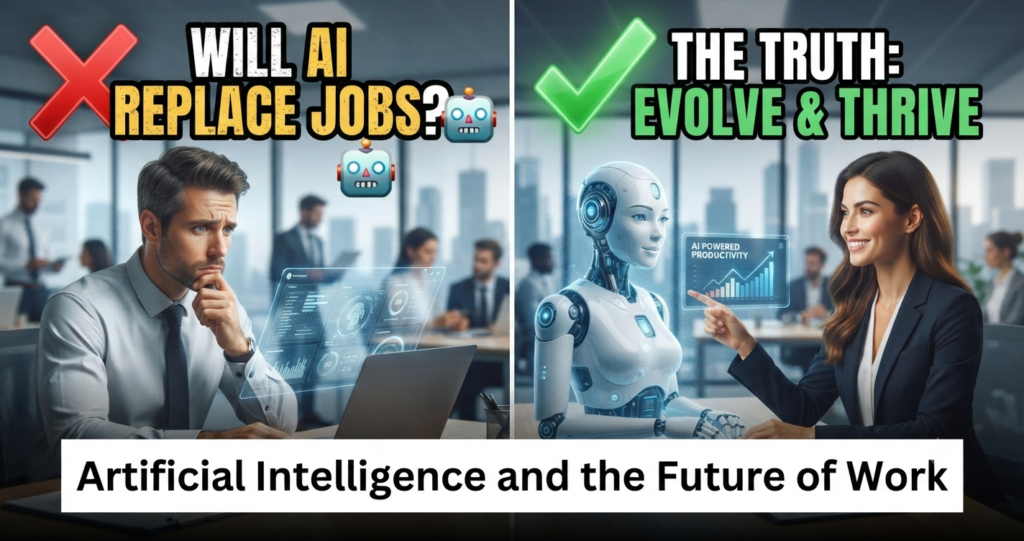
Will AI Replace Jobs: Artificial Intelligence (AI) has become one of the most talked-about technologies of this decade. From ChatGPT writing emails to AI generating images, coding software, and even assisting doctors, AI is changing the way we work faster than many expected.
This rapid transformation has also raised an important question:
“Will AI replace my job?”
The answer isn’t as simple as “yes” or “no.” AI will replace certain tasks and reshape many jobs, but it is also creating new opportunities and increasing productivity across industries. Understanding this shift is more useful than fearing it.
The Rise of Artificial Intelligence
Over the last few years, AI has moved from research labs into everyday life.
Today, AI helps us:
- Write emails and reports
- Translate languages
- Generate images and videos
- Assist in programming
- Analyze medical scans
- Detect financial fraud
- Recommend movies and products
- Support customer service
Businesses are adopting AI because it can complete repetitive work quickly and help employees focus on more complex tasks.
Which Jobs Are Most Likely to Change?
AI is particularly effective at handling repetitive, predictable, and data-heavy tasks.

Some roles that are expected to see significant changes include:
- Basic data entry
- Routine customer support
- Simple content drafting
- Scheduling and administrative tasks
- Basic bookkeeping
- Standard report generation
This doesn’t necessarily mean these professions will disappear, but the nature of the work is likely to evolve.
Jobs That AI Is Helping Rather Than Replacing
Many careers rely on human judgment, creativity, empathy, and decision-making—areas where AI currently serves as an assistant rather than a replacement.
Examples include:
- Doctors and healthcare professionals
- Teachers and educators
- Lawyers handling complex cases
- Scientists and researchers
- Engineers
- Skilled trades
- Psychologists and counselors
- Creative professionals such as filmmakers, designers, and writers
In these fields, AI can automate repetitive tasks, but people remain responsible for critical thinking, ethics, and final decisions.
New Careers Created by AI
Just as the internet created web developers, digital marketers, and app developers, AI is generating entirely new career paths.

Some emerging roles include:
- AI Prompt Engineer
- AI Product Manager
- Machine Learning Engineer
- AI Ethics Specialist
- AI Trainer
- Data Scientist
- AI Security Analyst
- Automation Consultant
Demand for professionals who can work alongside AI is increasing across many industries.
Skills That Will Matter Most
Instead of asking whether AI will replace jobs, a more useful question is:
“Which skills will remain valuable?”
The most future-ready skills include:
- Critical thinking
- Problem solving
- Communication
- Creativity
- Leadership
- Data literacy
- AI tool proficiency
- Programming (where relevant)
- Adaptability and continuous learning
People who combine domain expertise with AI tools are likely to have an advantage.
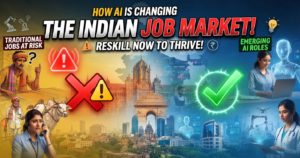
How AI Is Changing the Indian Job Market
India is rapidly embracing AI across sectors such as IT, healthcare, education, finance, manufacturing, and government services.
Many companies now expect employees to understand AI-assisted workflows. At the same time, India’s startup ecosystem is creating new AI products and services, generating demand for skilled professionals.
For students and working professionals alike, learning how to use AI effectively can become a valuable career asset.
Should Students Be Worried?
Not necessarily.
Students entering the workforce should focus on building skills that complement AI rather than compete with it.
This includes:
- Learning digital tools
- Understanding AI fundamentals
- Improving communication
- Developing analytical thinking
- Building practical project experience
Graduates who learn how to work with AI are likely to be better prepared for future workplaces.
Can AI Replace Human Creativity?
AI can generate ideas, write drafts, and create artwork based on prompts.
However, human creativity still plays a central role in:
- Original storytelling
- Emotional understanding
- Cultural context
- Strategic decision-making
- Innovation
- Ethical judgment
The strongest results often come from people using AI as a creative partner rather than relying on it completely.
Common Myths About AI
Myth 1: AI will replace every job.
Reality: AI is more likely to automate specific tasks within many jobs rather than eliminate all roles.
Myth 2: Only programmers need AI skills.
Reality: Professionals in marketing, healthcare, education, law, finance, media, and many other fields can benefit from understanding AI tools.
Myth 3: AI is always correct.
Reality: AI systems can make mistakes, generate inaccurate information, or reflect biases. Human review remains essential.
How to Future-Proof Your Career
If you want to stay competitive in an AI-driven world:
- Learn AI tools relevant to your profession.
- Continue developing human-centered skills.
- Stay updated with industry trends.
- Build a portfolio of practical work.
- Treat learning as a continuous process.
The people most likely to succeed are those who adapt rather than resist change.
Final Thoughts
Artificial Intelligence is transforming the workplace, but history shows that technological revolutions often change jobs more than they eliminate them.
The printing press, electricity, computers, and the internet all reshaped industries while creating entirely new professions. AI is likely to follow a similar path.
Instead of asking whether AI will replace humans, perhaps the better question is:
“How can humans work smarter with AI?”
Those who learn, adapt, and use AI responsibly will be better positioned for the opportunities ahead.
📌 FAQ Section
Q. Will AI replace software engineers?
AI can automate some coding tasks, but software engineers are still needed for system design, architecture, debugging, collaboration, and complex problem-solving.
Q. Which jobs are safest from AI?
Jobs requiring empathy, leadership, hands-on skills, creativity, or complex judgment—such as healthcare, teaching, skilled trades, and management—are less likely to be fully automated.
Q. Is AI a threat to freshers?
AI changes the skills employers look for, but freshers who learn AI tools and practical problem-solving can remain highly competitive.
Q. Should students learn AI?
Yes. Even a basic understanding of AI tools and concepts can improve productivity and career readiness across many fields.
📢 Conclusion
Artificial Intelligence is not just a technological trend—it’s becoming a part of everyday work and life. While some tasks will be automated, new roles, industries, and opportunities are also emerging.
The future belongs not to those who fear AI, but to those who learn how to use it effectively.
📢 Stay tuned to our blog for daily updates across India! Bookmark this page to get the latest rates every day.
And also visit our page for latest news : https://5pmnews.com
and our YouTube Channel for more informative video this Ritual : https://www.youtube.com/@5PMNewsgyan
Also Watch Visit us on Instagram Channel for more informative reel on this Ritual: https://www.instagram.com/
For any Law related information do visit our page : https://lawyersgyan.com/