
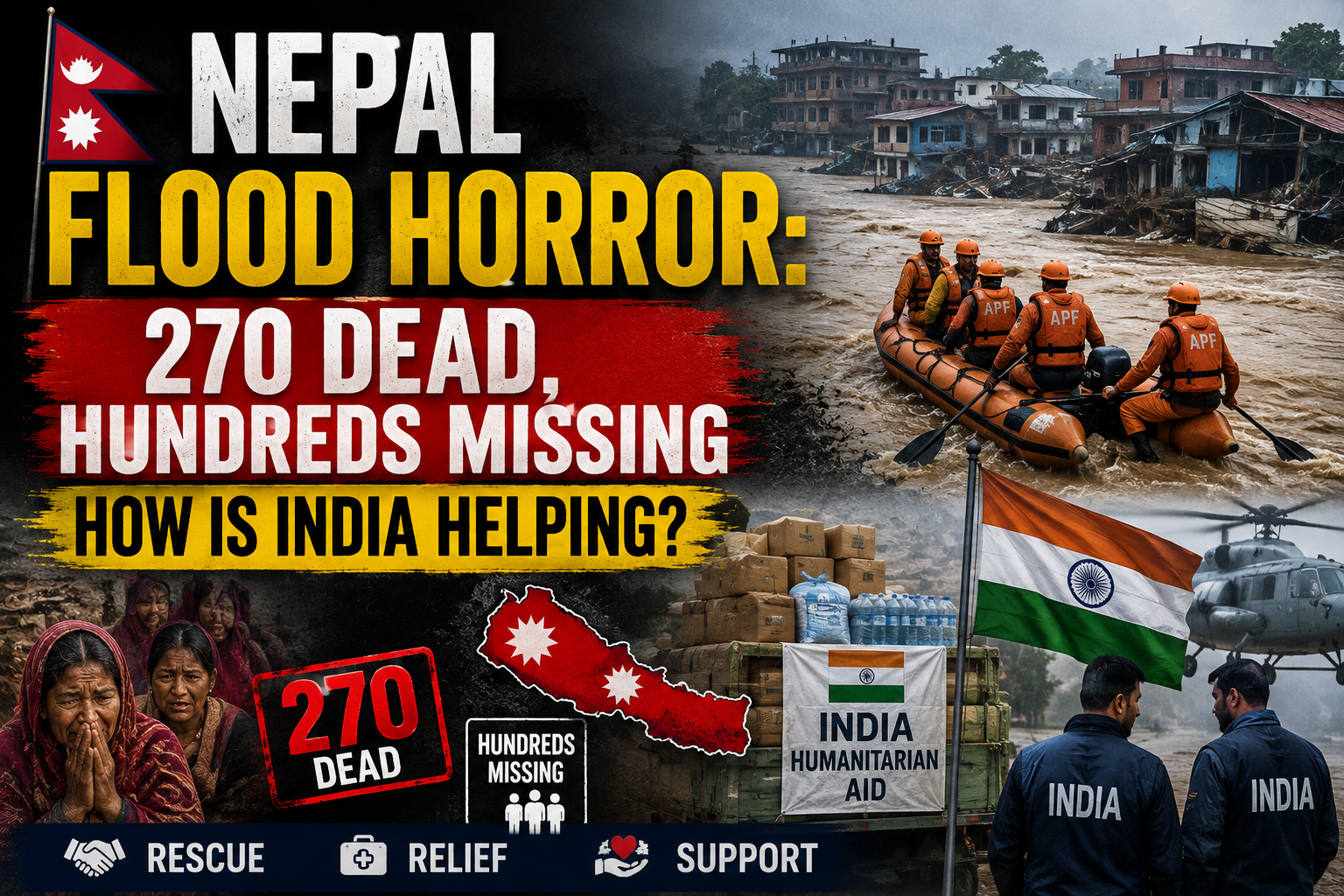
Nepal Is Facing a Catastrophic Flood Disaster (Nepal Flood)
A devastating flash flood has swept through parts of Nepal, leaving a trail of death, destruction and thousands of anxious families searching for information about missing relatives.
As of August 27, 2026, Nepal Police reported that 270 bodies had been recovered after Wednesday’s disaster. Nepal’s National Disaster Risk Reduction and Management Authority separately reported 826 people still out of contact, including residents, security personnel and tourists.
The disaster has also affected people from several countries, with tourists and religious pilgrims among those still unaccounted for.
And for India, the crisis has an additional dimension: Indian nationals are among those missing.
The Centre said on Thursday that 288 Indian nationals remained uncontactable in Nepal, while 21 Indians had been rescued and were receiving assistance in Kathmandu.
The figures are changing as rescue teams recover bodies and authorities reconcile missing-person lists, so casualty numbers should be treated as live figures rather than a final toll.
🌊 What Happened in Nepal?
The disaster struck on Wednesday, August 26, along the Nepal-Tibet border, particularly around the Rasuwa and Bhotekoshi River region.
A sudden surge of water and debris swept through communities and infrastructure along the river system.
Current reporting links the flash flood to an avalanche/glacial collapse that blocked the flow of the Lhende tributary, producing a sudden and devastating release of water downstream.
The event was so sudden that people in affected areas had little time to react.
The disaster zone includes mountainous terrain and areas used by tourists, trekkers and pilgrims travelling between Nepal and Tibet.
💔 270 Lives Lost — And the Number May Still Rise
The latest Nepal Police figure puts the death toll at 270.
According to The Kathmandu Post, the recovered bodies include:
- 108 in Chitwan
- 62 in Nawalparasi East
- 27 in Dhading
- 20 in Gorkha
- 17 in Rasuwa
- 15 in Nawalparasi West
- 12 in Nuwakot
- 9 in Tanahun
The same report said 826 people remained out of contact as of the latest update.
That means the final toll could still change significantly as search teams reach more affected areas.
🔎 How Many People Are Missing?
This is where the numbers become complicated.
Nepal’s authorities have been updating different categories of missing people as information comes in.
The National Disaster Risk Reduction and Management Authority reported 826 people out of contact, while the wider Nepal-Tibet disaster has left well over 1,000 people unaccounted for across both sides of the border.
Among those missing in Nepal are:
- Local residents
- Security personnel
- Domestic tourists
- Foreign tourists
- Religious pilgrims
- Workers in affected infrastructure projects
The situation is further complicated because communications in some affected areas have been disrupted.
🇮🇳 Why India Is Especially Worried
One of the most concerning parts of the disaster for India is the number of Indian nationals who are unaccounted for.
The Centre said 288 Indians remained uncontactable, while 21 had been rescued and were being assisted in Kathmandu.
Some of the missing Indians include people travelling in connection with the Kailash Mansarovar pilgrimage.
The disaster occurred along a route used by pilgrims and tourists travelling between Nepal and Tibet, putting international travellers directly in the path of the flooding.
Reuters reported that families across India were seeking information about relatives who had travelled through the region.
🚌 The Pilgrims Caught in the Disaster
Among the people affected are groups travelling towards the Kailash Mansarovar region.
Reuters reported that one group of 57 Indian pilgrims was travelling through Nepal toward Mount Kailash. According to the report, only one of three buses in that group passed safely, while another reportedly plunged into a gorge.
Another group connected with the Isha Foundation also reported dozens of pilgrims missing after contact was lost during border clearance.
These cases illustrate why the disaster has become an international rescue operation rather than a purely local emergency.
🏚️ The Scale of Destruction
The flood did not simply inundate homes.
It tore through the infrastructure people depend on.

Reports from the affected region describe damage to:
🏠 Homes and settlements
🌉 Bridges
🛣️ Roads
⚡ Hydropower infrastructure
🚗 Vehicles
🏢 Buildings and facilities along river corridors
The Kathmandu Post reported that the flooding damaged settlements, roads, bridges and other infrastructure as the water moved downstream through the Trishuli and Narayani river systems.
In mountainous terrain, destroying a bridge or road can be almost as serious as the flooding itself.
Why?
Because it can cut off entire communities from:
- Rescue teams
- Hospitals
- Food
- Drinking water
- Communication
- Transport
🚁 Nepal’s Rescue Operation
Nepal has mobilised security forces and emergency teams to search for survivors and recover bodies.
The operation includes:
- Nepal Army
- Nepal Police
- Armed Police Force
- Local authorities
- Emergency responders
- Helicopter operations
More than 800 people who were stranded or injured have reportedly been rescued, according to the latest reporting.
But the terrain is making the operation extremely difficult.
Floodwater has destroyed roads and bridges, while debris continues to block access to affected locations.
🇮🇳 So, How Is India Helping Nepal?
India responded quickly after the disaster.
Prime Minister Narendra Modi spoke with Nepal’s Prime Minister Balendra Shah, conveyed condolences and offered India’s “all possible humanitarian assistance.”
India subsequently began sending emergency relief supplies.
The first aircraft carried approximately 10 tonnes of humanitarian assistance and disaster-relief material, including:
- Temporary shelters
- Blankets
- Hygiene kits
- Solar lamps
- Medicines
But India’s assistance did not stop there.
✈️ India Sends a Second Relief Consignment
On August 27, India sent a second consignment to flood-hit Nepal.
The military transport aircraft carried 37.5 tonnes of:
💊 Medicines
🍱 Food packets
🛟 Humanitarian assistance
📦 Disaster-relief supplies
External Affairs Minister S. Jaishankar said India remains in close and continuous contact with Nepalese authorities and will continue supporting relief efforts.
Together, the two consignments amount to 47.5 tonnes of relief supplies sent by India so far, according to the Ministry of External Affairs.
🇮🇳 India Is Also Trying to Trace Missing Indians
India’s response isn’t limited to sending material.
The Ministry of External Affairs and Indian officials are coordinating with Nepalese authorities to locate Indian nationals who remain uncontactable.
India has also established channels for families seeking information about relatives caught in the disaster.
This is particularly important because communications in the affected region have been disrupted.
A person being “uncontactable” therefore does not automatically mean that person has died.
That distinction is crucial.
🌏 Why Are the Missing Figures So Confusing?
If you follow different reports, you may see numbers such as:
270 dead
826 out of contact in Nepal
288 Indians uncontactable
More than 1,000 missing across Nepal and Tibet
Nearly 1,500 missing in the wider disaster
Why are there different figures?
Because different authorities are counting different geographic areas and categories.
Some numbers cover Nepal alone.
Others include Tibet.
Some count only officially registered tourists.
Others include residents, workers and security personnel.
And rescue teams are still updating their lists.
For 5PM NEWS GYAN, the safest editorial approach is therefore:
“270 deaths have been reported in Nepal, while hundreds remain out of contact; the wider Nepal-Tibet disaster has left more than 1,000 people missing.”
And always include the date and time of the figure.
🧊 What Caused the Flash Flood?
The disaster is being linked to a sudden glacial/ice-related collapse and landslide, which blocked the Lhende tributary and sent a huge surge of water downstream.
This is different from a normal seasonal river flood.
A sudden blockage followed by a release can create a flash-flood effect, giving communities very little warning.
The Himalayan environment makes such disasters particularly dangerous because steep slopes can rapidly channel water and debris into narrow valleys.
🌡️ Is Climate Change Responsible?
This question needs careful treatment.
The Himalayan region is warming and glaciers are changing, and scientists have warned about increasing risks associated with unstable ice, glacial lakes and extreme events.
But it would be irresponsible to claim that climate change alone caused this specific flood without a scientific attribution study.
The immediate trigger reported by authorities and news agencies is the glacial/ice-related collapse and resulting sudden water surge.
The broader climate connection remains an important subject for scientific investigation.
⚠️ The Rescue Mission Is Still Ongoing
The disaster is not yet a closed chapter.
Search teams are still working to:
🔎 Locate missing people
🚁 Reach isolated communities
🏥 Provide medical assistance
📋 Identify recovered bodies
🇮🇳 Locate missing Indian nationals
🏠 Support displaced families
🌉 Reopen essential routes
And every hour matters.
The more time passes, the more difficult rescue operations can become—especially in areas where roads, bridges and communication infrastructure have been destroyed.
🇳🇵 Nepal Needs More Than Immediate Relief
Emergency supplies can help people survive the first days.
But rebuilding will take much longer.
Affected communities will need:
Food and clean water
Temporary housing
Medical support
Road and bridge reconstruction
Power restoration
Livelihood support
Mental-health and family assistance
Reconstruction of critical infrastructure
The disaster therefore has the potential to become a long-term humanitarian and economic challenge for Nepal.
🇮🇳 Why India’s Response Matters
Nepal and India share a close geographic, cultural and people-to-people relationship.
For India, this disaster has two dimensions.
Humanitarian
Help a neighbouring country recover from a devastating natural disaster.
Consular
Locate and assist Indian citizens caught in the affected region.
That’s why India’s response involves both relief supplies and coordination to trace missing nationals.
❓ 7 Questions Everyone Is Asking
1. How many people have died in Nepal?
The latest Nepal Police figure available on August 27 puts the death toll at 270.
2. How many are missing?
Nepal’s disaster authority reported 826 people out of contact in Nepal, while the wider Nepal-Tibet disaster has left more than 1,000 people unaccounted for.
3. How many Indians are missing?
The Indian government said 288 Indian nationals remain uncontactable, while 21 Indians have been rescued.
4. What caused the flood?
Reports link it to a sudden glacial/ice-related collapse that blocked a tributary and triggered a devastating flash flood.
5. How badly was Nepal damaged?
Homes, roads, bridges, settlements and hydropower infrastructure were damaged or destroyed across affected areas.
6. How much aid has India sent?
India has sent two aircraft carrying a combined 47.5 tonnes of relief supplies, including medicines, food and humanitarian/disaster-relief material.
7. Is the rescue operation over?
No. Search and rescue operations are still continuing, and the missing-person numbers are being updated.
🇳🇵 A Disaster Still Unfolding
The headline numbers are devastating:
270 dead.
Hundreds still unaccounted for.
288 Indians uncontactable.
Massive infrastructure destruction.
Rescue operations still underway.
But behind every number is a person.
A family waiting for a phone call.
A pilgrim who has not returned.
A child waiting for a parent.
A community searching through debris.
And right now, rescue teams in Nepal are racing against time.
India has begun sending humanitarian assistance and helping coordinate efforts to trace its citizens.
But the biggest question remains:
How many survivors can still be found?
For now, the search continues.
Nepal needs rescue. Nepal needs relief. And Nepal needs the world to keep watching. 🇳🇵❤️
📰 Editorial Note
The casualty and missing-person figures in this article are live figures as of August 27, 2026 and may change as rescue operations continue. Different agencies are reporting different totals because they cover different geographic areas and categories of people.
We have deliberately distinguished between “dead,” “missing,” and “uncontactable.” Being uncontactable does not necessarily mean a person has died.
📖 Related Reading
➡️ Will AI Replace Jobs? The Truth About Artificial Intelligence and the Future of Work
➡️🏛️ How Does Parliament Pass a Law? A Step-by-Step Guide
➡️ 🛡️ Digital Suraksha – Episode #01: UPI Safety Tips Every User Should Know
➡️ 💰 Why Is Everything Getting Expensive Again?
➡️ ✈️ IndiGo Employee Allegations Explained: What Actually Happened?
➡️ Top 10 News Headlines – 17 July 2026
📢 Stay tuned to our blog for daily updates across India! Bookmark this page to get the latest rates every day.
And also visit our page for latest news : https://5pmnews.com
and our YouTube Channel for more informative video this Ritual : https://www.youtube.com/@5PMNewsgyan
Also Watch Visit us on Instagram Channel for more informative reel on this Ritual: https://www.instagram.com/
For any Law related information do visit our page : https://lawyersgyan.com/